Disclosing Generative AI Use in Digital Humanities Research
Project Developers
Menu
Site Under Development
This project is under active development. We anticipate it being completed in 2026. Get notified about updates using this form.
Abstract
This project investigates how digital humanists perceive and approach generative AI (GenAI) disclosure in research. It is based on a survey that we conducted in 2025. The results indicate that while digital humanities scholars acknowledge the importance of disclosing GenAI use, the actual rate of disclosure in research practice remains low. Respondents differ in their views on which activities most require disclosure and on the most appropriate methods for doing so. Most also believe that safeguards for AI disclosure should be established through institutional policies rather than left to individual decisions. The study’s findings will offer empirical guidance to scholars, institutional leaders, funders, and other stakeholders responsible for shaping effective disclosure policies.
Background
Generative AI (GenAI) now permeates almost every aspect of daily life and has become integral to academic work. Although its use offers clear benefits to researchers, it also raises challenging questions about academic integrity and research ethics (Van Noorden & Perkel, 2023; Hosseini et al., 2023; Abdelhafiz et al., 2024; Dedema & Ma, 2024; Ng et al., 2025). Disclosure has therefore emerged as a potential policy solution.
Resnik & Hosseini (2026) propose a three-tier framework distinguishing mandatory, optional, and unnecessary disclosure. This framework demonstrates the increasingly nuanced guidance now issued by publishers. Publishers agree that GenAI tools cannot be listed as authors, yet their disclosure policies vary.
| Aspect | Current State |
|---|---|
| Disclosure Distinctions | Most publishers distinguish between routine language polishing (grammar, spelling) and substantive content generation: the former typically escapes disclosure, whereas the latter demands it (International Association of Scientific, Technical & Medical Publishers [STM], 2025) |
| Strict Implementation | Journals such as Science (American Association for the Advancement of Science [AAAS], 2023) and Wiley (2023) titles require detailed statements describing the software, provider, and prompts used, with authors affirming full responsibility |
| Moderate Implementation | Springer Nature (2023) insists that generative use be “properly documented” while exempting minor editing |
| Lenient Implementation | IOP Publishing (n.d.) merely encourages transparency and reminds authors they remain accountable for all content |
Table 1. Variations in publisher GenAI disclosure policies.
However, policies that mandate AI disclosure can produce unintended consequences. Empirical research has identified an “AI disclosure penalty” in both professional and creative domains. The magnitude varies by context: professional settings show moderate penalties (Reis et al., 2024; Proksch et al., 2024); creative contexts show smaller but still significant penalties (Horton et al., 2023). Studies consistently suggest AI disclosure reduces perceived credibility across multiple contexts (Longoni et al., 2021; Lermann Henestrosa & Kimmerle, 2024).
Given these context-dependent penalties, understanding how different audiences interpret AI disclosure is important. A recent Nature survey reveals deep divisions among scholars over whether GenAI use should be declared at all and, if so, how much detail such declarations should include (Kwon, 2025).
Research Questions
Summary
This survey study investigates how digital humanists perceive and approach generative AI (GenAI) disclosure in research. We contend that a community-centered lens is essential for navigating the complex terrain of AI disclosure, where formal policies intersect with the professional cultures that ultimately determine their uptake. Therefore, we adopt a community-based approach in this study, exploring how researchers view GenAI disclosure and how their views might shape future disclosure policies. We focus on the digital humanities community as a case study, an inherently interdisciplinary field that brings together scholars with diverse expertise (Luhmann & Burghardt, 2022), to gauge attitudes toward declaring GenAI use in research.
Questions
- How do digital humanists perceive and approach disclosure of generative AI (GenAI) use in research?
- In particular, to what extent do digital humanists regard disclosure of GenAI use as necessary?
- More particularly, in which research contexts should GenAI disclosure be practiced, for what specific activities, and in what forms?
- Finally, who should be responsible for developing and enforcing GenAI disclosure policies? Why?
Methodology
Qualtrics Survey
- Distributed 20 February to 6 May 2025 via social media (Bluesky, Slack, LinkedIn) and digital humanities mailing lists
- Digital humanists self-identify due to lack of clear definition for “digital humanist” (Ma, 2022; Ramsay, 2013)
- 30 questions organized into 3 sections:
- Demographics
- GenAI Disclosure Perceptions and Practices
- GenAI Personal Use and Literacy
Responses
- 152 total responses; after data cleaning, 99 fully completed surveys remain
- Respondents:
- span a wide range of digital humanities subfields: e.g., literary and cultural studies, history, information science
- represent a geographically diverse community across the United States, United Kingdom, European Union, China, and beyond
- hold positions ranging from undergraduate to full professor; independent scholars also included
Main Project Objective
Our project seeks to offer empirical guidance to scholars, institutional leaders, funders, and other stakeholders who are responsible for shaping effective AI disclosure policies.
Results
The survey study reveals a shared recognition of the importance of disclosing GenAI use, but divergent views on how such disclosure should be integrated into research practices.
Respondents differ in their views on which activities most require disclosure and on the most appropriate methods for doing so.
Most also believe that safeguards for AI disclosure should be established through institutional policies rather than left to individual decisions.
Results: Overview
- There is a GenAI disclosure perceptions mismatch among digital humanists:
- 72% of researchers who never disclosed GenAI use perceive it “very necessary” to disclose GenAI use.
- Only 43% of researchers who disclosed GenAI use voluntarily perceive it "very necessary" to disclose GenAI use.
- Researchers consider it more important to disclose GenAI use in developmental and dissemination research stages.
Conference Presentation
The project developers submitted a research abstract and poster (Figure 2) on "Disclosing Generative AI Use in Digital Humanities Research" to the Association for Information Science and Technology (ASIS&T) Conference, which occurred in Washington, D.C. on November 14-18, 2025.
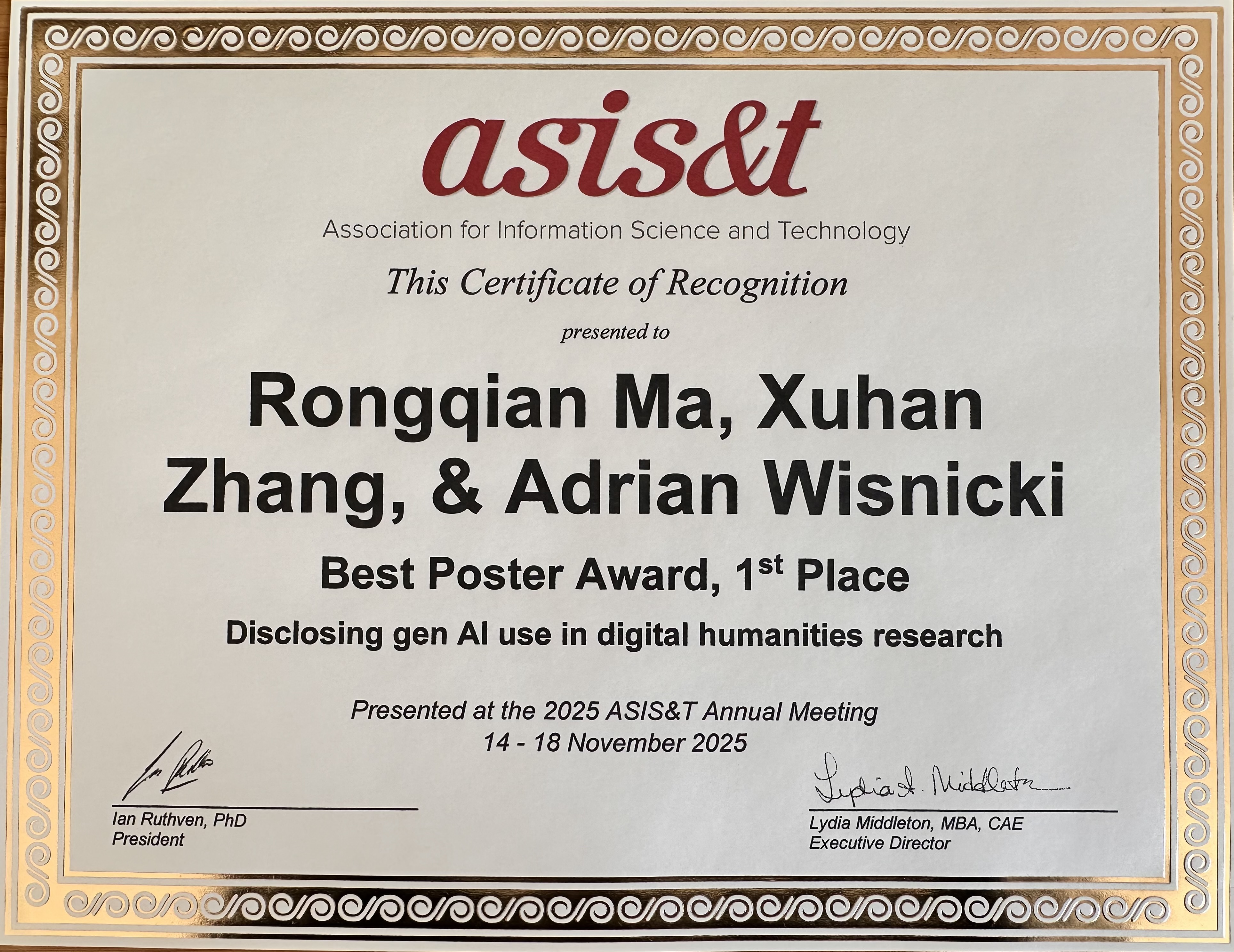
At the conclusion of the ASIS&T Conference, the project developers learned that the conference had awarded their submission "Best Poster Award, 1st Place" (Figure 3).
Works Cited
- Abdelhafiz, A. S., Ali, A., Maaly, A. M., Ziady, H. H., Sultan, E. A., & Mahgoub, M. A. (2024). Knowledge, perceptions and attitude of researchers towards using ChatGPT in research. Journal of Medical Systems, 48(1), Article 26.
- American Association for the Advancement of Science. (2023, November 16). Change to policy on the use of generative AI and large language models. Science.
- Dedema, M., & Ma, R. (2024). The collective use and perceptions of generative AI tools in digital humanities research: Survey-based results [Preprint]. arXiv.
- Horton, C. B., Jr., White, M. W., & Iyengar, S. S. (2023). Bias against AI art can enhance perceptions of human creativity. Scientific Reports, 13, Article 19001.
- Hosseini, M., Resnik, D. B., & Holmes, K. (2023). The ethics of disclosing the use of artificial intelligence tools in writing scholarly manuscripts. Research Ethics, 19(4), 449–465.
- International Association of Scientific, Technical & Medical Publishers. (2025). Draft report: Classifying AI use in manuscript preparation. STM Association.
- IOP Publishing. (n.d.). Artificial intelligence.
- Kwon, D. (2025). Is it OK for AI to write science papers? Nature survey shows researchers are split. Nature, 641(8063), 574–578.
- Lermann Henestrosa, A. L., & Kimmerle, J. (2024). The effects of assumed AI vs. human authorship on the perception of a GPT-generated text. Journalism and Media, 5(3), 1085–1097.
- Longoni, C., Fradkin, A., Cian, L., & Pennycook, G. (2021). News from artificial intelligence is believed less (SSRN Working Paper No. 3787064). Social Science Research Network.
- Luhmann, J., & Burghardt, M. (2022). Digital humanities—A discipline in its own right? An analysis of the role and position of digital humanities in the academic landscape. Journal of the Association for Information Science and Technology, 73(2), 148–171.
- Ma, R. (2022). Revisiting connotations of digital humanists: Exploratory interviews. Proceedings of the Association for Information Science and Technology, 59(1), 750–752.
- Ng, J. Y., Maduranayagam, S. G., Suthakar, N., Li, A., Lokker, C., Iorio, A., Haynes, R. B., & Moher, D. (2025). Attitudes and perceptions of medical researchers towards the use of artificial intelligence chatbots in the scientific process: An international cross-sectional survey. The Lancet Digital Health, 7(1), e94–e102.
- Proksch, S., Schühle, J., Streeb, E., Weymann, F., Luther, T., & Kimmerle, J. (2024). The impact of text topic and assumed human vs. AI authorship on competence and quality assessment. Frontiers in Artificial Intelligence, 7, Article 1412710.
- Ramsay, S. (2013). Who’s in and who’s out. In M. Terras, J. Nyhan, & E. Vanhoutte (Eds.), Defining digital humanities: A reader (pp. 239–241). Ashgate.
- Reis, M., Reis, F., & Kunde, W. (2024). Influence of believed AI involvement on the perception of digital medical advice. Nature Medicine, 30(11), 3098–3100.
- Resnik, D. B., & Hosseini, M. (2026). Disclosing artificial intelligence use in scientific research and publication: When should disclosure be mandatory, optional, or unnecessary? Accountability in Research, 33(2), Article 2481949.
- Springer Nature. (2023). Editorial policies: “Artificial intelligence”.
- Van Noorden, R., & Perkel, J. M. (2023). AI and science: What 1,600 researchers think. Nature, 621(7980), 672–675.
- Wiley. (2023). Generative artificial intelligence guidelines for authors [Policy document].